

Why Do Buddhas Look So Different?
From Greco-Roman drapery to the fluid bronze of Sukhothai, Buddhist iconography maps the translation of spiritual ideals across shifting cultural terrains.
Why can the same historical figure appear as a lean, Greek-influenced scholar in one century and a jovial, round-bellied monk in the next? A slender Thai bronze with its characteristic flame-topped crown looks nothing like the folk-inspired Chinese Budai, yet both are recognized as “Buddha.” These differences aren’t contradictions; they are the result of centuries of cultural translation.
As Buddhism moved along trade routes and crossed borders, artists didn’t simply copy existing icons. They reinterpreted the iconography through their own aesthetic values and local materials. The resulting diversity in Buddhist art shows how a universal spiritual concept takes on the physical characteristics and cultural priorities of the people who adopt it, transforming a single lineage into a vast visual language.
The Aniconic Era
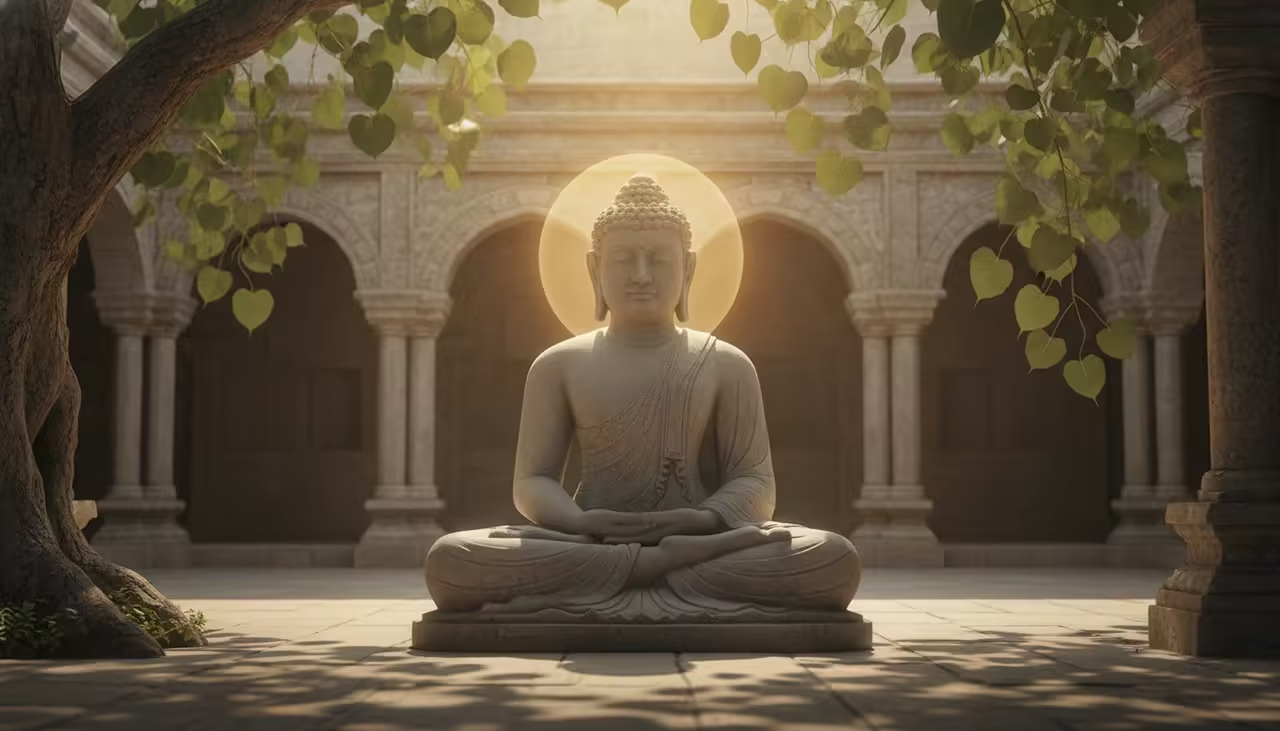
For roughly the first five centuries following the Buddha’s death, his physical likeness was entirely absent from religious art. This wasn’t due to a lack of technical capability, but rather a specific theological stance. Because the Buddha had attained Nirvana—transcending the cycle of rebirth and form—early practitioners believed that carving him into a human shape would be a contradiction. To represent him as a physical being was to ignore the very liberation he taught.
Instead of a body, the art of this period used a vocabulary of symbols to mark his presence. An empty throne beneath a Bodhi Tree represented his enlightenment; the buddhapada (footprints) marked his earthly journey; and the Dharmachakra, or Wheel of Law, signified the start of his teachings. These were not mere placeholders, but tools for practitioners to focus on the Dhamma—the path itself—rather than the personality of the teacher.
During this time, the primary object of veneration was the stupa. As a reliquary mound containing physical remains or sacred texts, the stupa functioned as a monument to the Buddha’s final parinirvana. It anchored the community’s devotion to the reality of his passing and the permanence of his message, keeping the focus on the spiritual legacy he left behind rather than his human form.
The Gandharan Synthesis
The transition from symbolic representation to the human form took place around the 1st century CE in Gandhara, a region encompassing parts of modern-day Pakistan and Afghanistan. As a vital hub on the Silk Road, Gandhara served as a cultural melting pot where the Hellenistic legacy of Alexander the Great’s successors intersected with the expanding influence of Buddhist thought.
When local craftsmen began carving the first anthropomorphic Buddhas, they naturally utilized the aesthetic vocabulary they were trained in: Greco-Roman sculpture. These early figures carry the distinct features of classical Western deities. The wavy hair gathered in a topknot mirrors the iconography of Apollo, and the sanghati—the monastic robe—is depicted with the heavy, rhythmic folds characteristic of a Roman toga, emphasizing physical volume and realistic drapery.
This shift toward naturalism gave the Buddha a tangible, human presence that was entirely absent during the aniconic era. By applying Mediterranean artistic techniques to Indian spirituality, Gandharan artists created a visual bridge. This hybrid style provided the initial blueprint for Buddhist iconography, establishing a human likeness that would eventually be adapted and transformed by every culture the religion reached further East.
The first human images of the Buddha were born from this cultural overlap, using the established visual language of the Mediterranean to give a physical identity to the philosophy of the East.
Regional Diversification and Local Styles
While the Gandharan style was refining its Greco-Roman influences, a parallel and purely indigenous aesthetic emerged in Mathura. Carved from local mottled red sandstone, these Buddhas abandoned Mediterranean realism in favor of a powerful, terrestrial presence.
The Mathura style is defined by broad shoulders and expanded chests—suggesting prana, or sacred breath—with thin, transparent robes that cling to the body rather than drape. Unlike the toga-like folds of the north, these figures felt grounded in Indian sculptural traditions of the yaksha, or nature spirit.
As Buddhism moved into China, the aesthetic underwent another significant shift, reaching a stylistic peak during the Tang Dynasty (7th–10th century CE). This era saw the Buddha take on a more courtly and compassionate appearance, best observed in the massive carvings at the Longmen and Yungang Grottoes. Artists moved away from the lean, ascetic look of earlier periods toward fuller, more rounded faces and softer body contours. The drapery became less about physical volume and more about rhythmic, flowing lines that reflected a distinctly Chinese mastery of linear elegance.
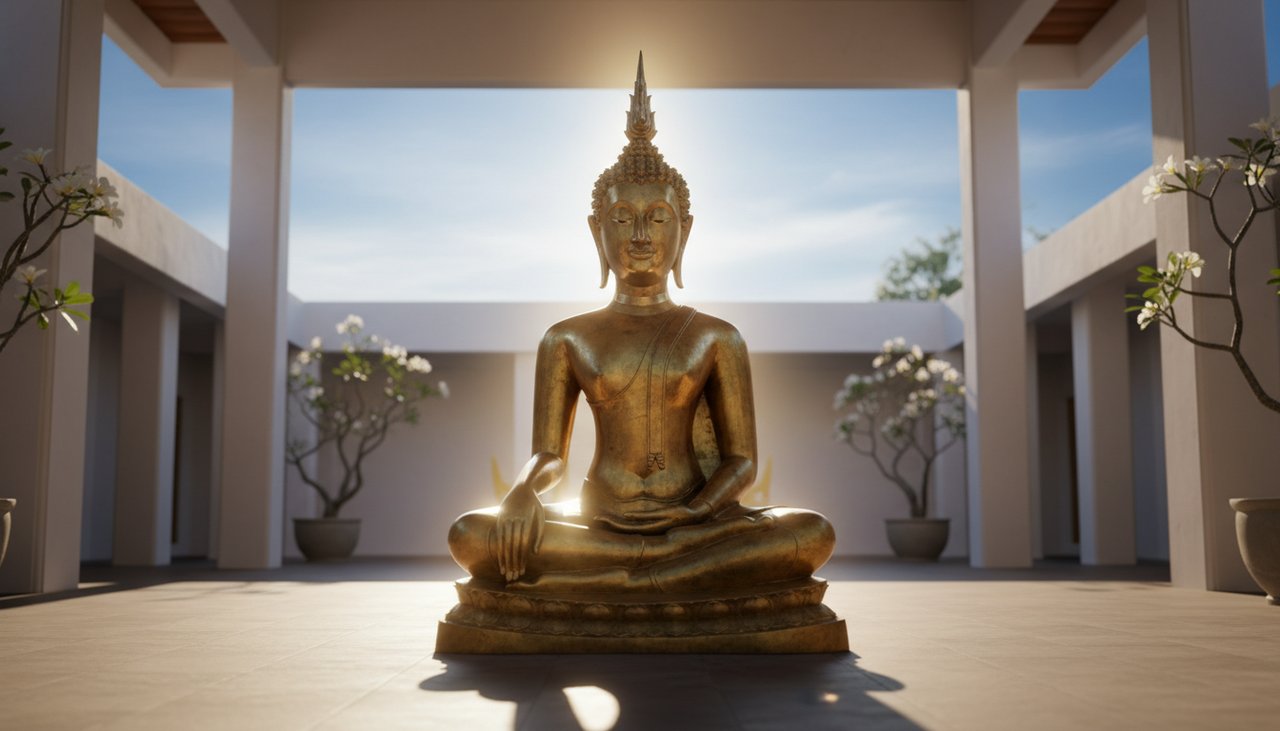
In Southeast Asia, particularly within the Sukhothai and Ayutthaya periods of Thailand, the human form was stylized into a state of ethereal abstraction. The Sukhothai “Walking Buddha” remains one of the most distinctive interpretations, featuring an elongated, fluid anatomy that lacks distinct muscle or bone structure.
These statues are characterized by an oval face, arched “parrot-beak” noses, and the ushnisha topped with a flame finial (rasmi), which represents the radiant spiritual energy of enlightenment.
The Iconography of Mudras
A Buddha statue functions as a visual text where meaning is coded into posture and gesture. While regional aesthetics vary, the specific mudras—or hand positions—identify the teaching or life event being represented. These gestures act as a universal sign language, identifying the Buddha’s state of being at a particular moment.
- Abhaya Mudra: This gesture of fearlessness and protection is shown by the right hand raised to shoulder height with the palm facing forward. It is traditionally linked to the Buddha’s pacification of a charging elephant, symbolizing the power of inner peace over external violence.
- Dhyana Mudra: Primarily seen in seated figures, this is the posture of meditation. The hands rest in the lap, right over left, with the thumbs touching to form a circle of energy. It signifies the deep concentration and mental stability required for spiritual realization.
- Bhumisparsha Mudra: Often considered the most significant gesture in Buddhist art, this is the earth-witness mudra. It depicts the Buddha seated with his right hand reaching down to touch the ground—marking the exact moment he overcame the temptations of the demon Mara and called upon the earth to testify to his spiritual resolve.

The “Laughing Buddha” Distinction
The most frequent point of confusion in Buddhist iconography is the “Laughing Buddha.” This heavy-set, jovial figure is not Siddhartha Gautama, the historical Buddha. He is Budai, a 10th-century Chinese monk and folk hero. While he is eventually regarded as an incarnation of Maitreya, the future Buddha, his presence in art focuses on earthly contentment, generosity, and prosperity rather than the specific path to nirvana.
Budai’s popularity reflects how Buddhist thought integrated with local Chinese values. It moved the imagery away from asceticism toward a more domestic expression of joy. Seeing Budai alongside a traditional Gandharan or Thai Buddha highlights the tradition’s extreme adaptability across different geographies and eras.
These diverse representations—whether the Greco-Roman features of ancient Gandhara, the courtly refinement of Tang Dynasty carving, or the fluid bronze work of Sukhothai Thailand—are not contradictions. They are different answers to the same question: what does awakening look like in this place, for these people, at this moment in history? Recognizing the logic behind each style changes how you read a statue. You stop seeing a decorative object and start seeing a record of how a philosophy survived its own travels.
Frequently Asked Questions
Why do Buddha statues vary so widely in appearance across different cultures?+
The diverse appearances of Buddha statues are a testament to centuries of cultural translation. As Buddhism spread along trade routes, local artists reinterpreted iconography through their own aesthetic values, indigenous materials, and spiritual priorities, transforming a universal concept into a vast visual language unique to each region and era.
Why was the Buddha not depicted in human form for several centuries after his death?+
For roughly the first five centuries, a specific theological stance prevailed: the Buddha, having attained Nirvana and transcended all earthly forms, should not be carved into a human shape. Early art instead used symbolic representations like an empty throne beneath a Bodhi Tree, the buddhapada (footprints), or the Dharmachakra (Wheel of Law) to focus on the Dhamma—the spiritual path—rather than his physical personality.
Where and when did the first anthropomorphic images of the Buddha emerge?+
The transition from symbolic representation to human-form Buddhas occurred around the 1st century CE in Gandhara, a vital Silk Road hub encompassing parts of modern-day Pakistan and Afghanistan. This cultural melting pot, influenced by the Hellenistic legacy of Alexander the Great, saw local craftsmen apply Greco-Roman sculptural techniques to Buddhist iconography.
What artistic traditions influenced the earliest human-form Buddha sculptures from Gandhara?+
The first anthropomorphic Buddhas from Gandhara drew heavily from Greco-Roman sculpture. Features like wavy hair gathered in a topknot, reminiscent of Apollo, and monastic robes depicted with heavy, rhythmic folds akin to a Roman toga, demonstrate a distinct Mediterranean aesthetic applied to Eastern spirituality.
How do hand gestures, or mudras, clarify the meaning of a Buddha statue?+
Mudras function as a universal sign language in Buddhist art, with each specific hand position identifying a particular teaching, life event, or state of being. These gestures allow for a precise visual communication of the Buddha's spiritual message, transcending regional stylistic differences and providing a coded text for practitioners.
What is the significance of the Bhumisparsha Mudra?+
The Bhumisparsha Mudra, or "earth-witness" gesture, is one of the most significant in Buddhist art. It depicts the Buddha seated with his right hand reaching down to touch the ground, symbolizing the exact moment he overcame the temptations of the demon Mara and called upon the earth to bear witness to his spiritual resolve and enlightenment.
Is the 'Laughing Buddha' the same figure as Siddhartha Gautama, the historical Buddha?+
No, the 'Laughing Buddha' is not Siddhartha Gautama. This heavy-set, jovial figure is Budai, a 10th-century Chinese monk and folk hero. While he is eventually regarded as an incarnation of Maitreya, the future Buddha, his imagery emphasizes earthly contentment, generosity, and prosperity, reflecting a local integration of Buddhist thought with Chinese values rather than the ascetic path to nirvana.
How did the representation of the Buddha evolve in China during the Tang Dynasty?+
During the Tang Dynasty (7th–10th century CE), Chinese Buddhist art adopted a more courtly and compassionate aesthetic. Buddhas from this era, notably seen in the massive carvings at the Longmen and Yungang Grottoes, feature fuller, more rounded faces, softer body contours, and drapery characterized by rhythmic, flowing lines, reflecting a distinctly Chinese mastery of linear elegance.