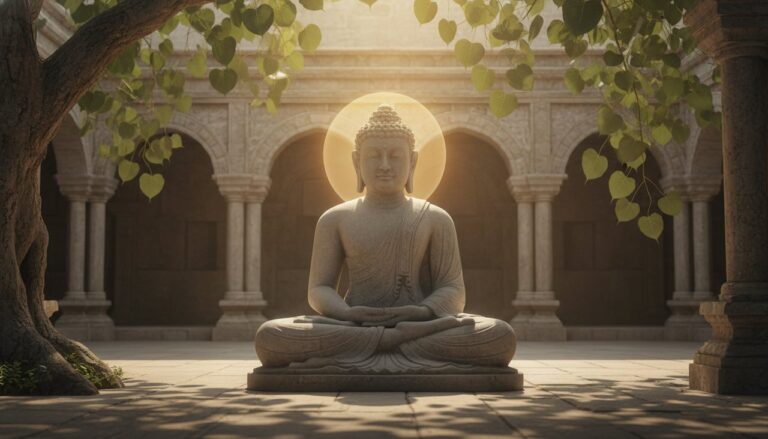

Who Was the Buddha?
Siddhartha Gautama’s path from prince to sage is a guide for the modern mind: finding balance amidst the relentless friction of existence.
Siddhartha Gautama was not born enlightened. He was born a prince—sheltered, comfortable, and deliberately kept from anything that might disturb him. That gap between his constructed world and reality is where everything begins.
He is known as “the Buddha,” a title meaning ‘The Awakened One,’ not a personal name. That distinction matters more than it might seem: the path he found wasn’t meant to end with him.
From Prince to Seeker
Siddhartha Gautama was born into a life of carefully maintained comfort in Lumbini, now modern-day Nepal—the son of a Shakya chieftain who had resolved that his heir would never have cause to look elsewhere for meaning.
Despite his privileged upbringing—marriage to Yasodhara, the birth of his son Rahula—Siddhartha’s destiny was not to remain within palace walls. On rare trips outside, he encountered what his father had spent years hiding: an old man, a sick man, a corpse, and a wandering ascetic. These are known as the Four Sights.
What made these encounters so shattering wasn’t the content—suffering and death are facts any adult knows. What broke Siddhartha was the realization that his entire life had been built on a deliberate omission. His comfort hadn’t eliminated suffering; it had simply kept it out of view. The wandering ascetic offered the counter-image: someone who had faced this reality directly, and found a different kind of peace.
At 29, Siddhartha made a momentous decision. He renounced his princely life, leaving his family and all worldly comforts, to embark on a spiritual quest for liberation. This act is known as the Great Renunciation.
Asceticism and the Middle Way
Siddhartha’s search for liberation was not straightforward. He initially sought wisdom from renowned ascetics, mastering various meditative states and philosophical doctrines. However, he found these teachings incomplete, failing to provide the ultimate cessation of suffering he sought.
He then embraced a period of extreme asceticism, enduring severe fasting and self-mortification for six years. This rigorous discipline brought him to the brink of death. He realized that such extremes were two sides of the same coin, both clouding the mind and hindering true insight.
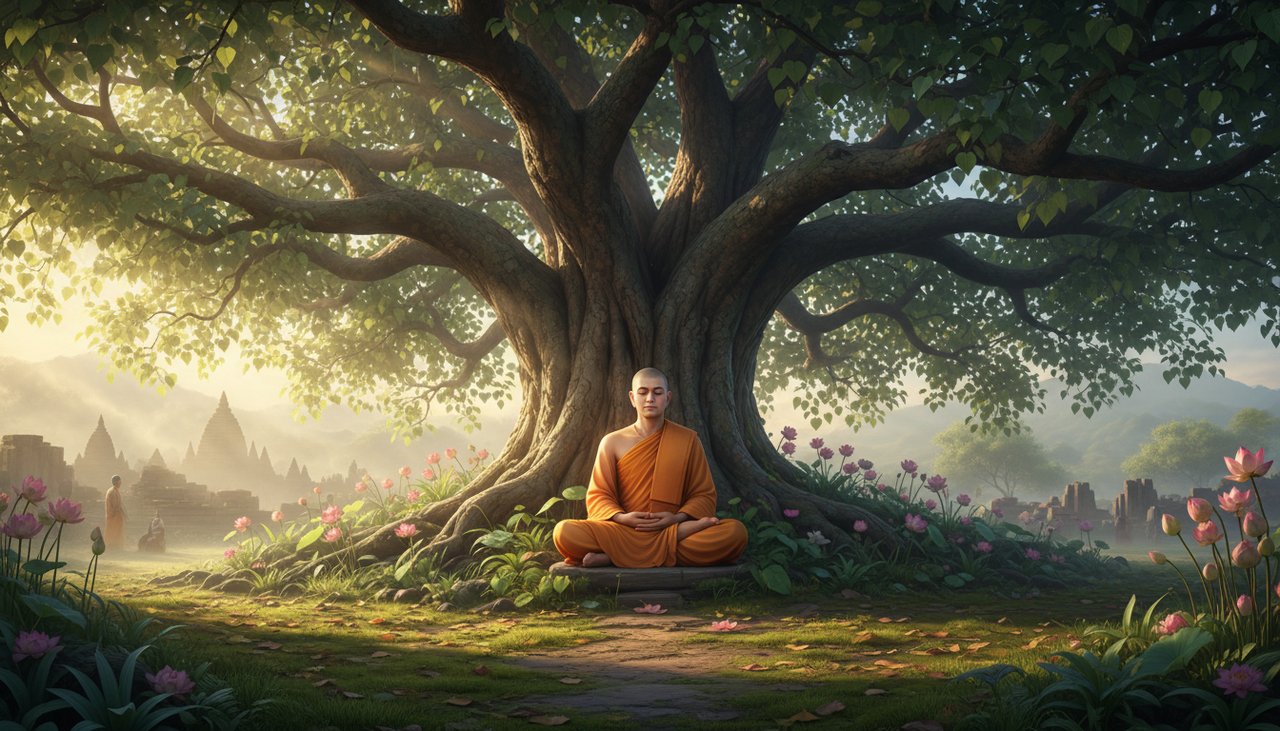
This led him to the ‘Middle Way,’ a path of elegant moderation. It’s a principle reflected in so much of Eastern art and philosophy: finding harmony not in extremes, but in the graceful balance between them.
Under a Bodhi tree in Bodh Gaya, Siddhartha—his body gaunt from years of self-denial, his mind honed to a single point by silence—sat down and made a quiet vow: he would not rise until he understood.
What followed was not peaceful. Mara, the force of temptation, rose against him with the full weight of desire and doubt, questioning his worthiness to reach what no comfort had ever given him.
He did not flinch. His mind, like the earth beneath him, held still. This internal battle is the oldest one there is—it raises the question of How Should Buddhists Handle Doubt?
Through deepening layers of stillness, the veil lifted. He saw his past lives scroll back across countless ages, perceived the full mechanics of rebirth, and grasped the Four Noble Truths and the Eightfold Path with absolute clarity.
In that moment, something released—not dramatically, but completely. Greed, hatred, and delusion burned away like mist at first light. He had achieved Nirvana. He was, at last, the Awakened One.
Four Noble Truths and the Eightfold Path
For the next 45 years, the Buddha walked the plains of India, sharing not a rigid doctrine, but a practical roadmap for the human mind. This framework is less a set of beliefs and more a diagnostic tool for understanding our own inner workings.
- First Noble Truth (Dukkha): Life involves suffering—dissatisfaction, impermanence, the inherent unsatisfactoriness of clinging to things that change. It’s not only physical pain. Think of the familiar restlessness that follows a big purchase or a long-awaited promotion—the way satisfaction quietly drains away before you’ve had time to enjoy it. That low-grade unease is Dukkha at work.
- Second Noble Truth (Samudaya): The origin of Dukkha is Tanha, or craving. This isn’t only obvious addiction—it’s the compulsive urge to check your phone for validation, the quiet desperation to have things stay exactly as they are, or equally, to escape them entirely. Tanha manifests as craving for pleasure, for existence, or for non-existence, perpetuating the cycle of suffering.
- Third Noble Truth (Nirodha): The cessation of Dukkha is possible. Letting go of craving leads to Nibbana (Nirvana)—not a blank absence, but a state of deep peace and freedom from compulsive reactivity.
- Fourth Noble Truth (Magga): The path to this cessation is the Noble Eightfold Path.

The Noble Eightfold Path is divided into three categories:
- Wisdom: Right Understanding, Right Thought
- Ethical Conduct: Right Speech, Right Action, Right Livelihood
- Mental Development: Right Effort, Right Mindfulness, Right Concentration
These aren’t abstract ideals; they are interconnected practices. Mental Development sits at the center of the whole framework—because without a trained mind, ethical conduct is effortful and wisdom stays theoretical. Right Mindfulness and Right Concentration are the tools that make the rest sustainable.
And unlike most self-help advice, they come with a method. A simple starting point for Right Mindfulness:
- Sit comfortably and close your eyes.
- Direct your full attention to the physical sensation of breathing—the air entering your nostrils, your chest or belly rising and falling.
- When your mind wanders (and it will), simply notice that it has wandered, and return your attention to the breath without judgment.
That’s the practice. Not achieving a blank mind—but repeatedly noticing where your attention has gone, and choosing where to place it. Done consistently, this builds Right Concentration: the capacity to hold focus steady under pressure.
Other Buddhas
Siddhartha Gautama is the Buddha most of us know—but the tradition he founded holds something far larger than one life, one tree, one moment of clarity.
Buddhist traditions universally acknowledge the existence of multiple Buddhas across various cosmic ages and realms. The specific understanding differs between major schools:
- Theravada Buddhism: Focuses primarily on a lineage of Buddhas who appear sequentially, rediscovering and teaching the Dharma when it has been lost. Siddhartha Gautama is the Buddha of our current age, with Maitreya prophesied as the next.
- Mahayana Buddhism: Works with a more expansive cosmology, positing countless Buddhas simultaneously across innumerable world-systems. These include past Buddhas such as Dipankara; present Buddhas like Amitābha (the Buddha of Infinite Light, presiding over the Pure Land and associated with the wisdom of compassionate perception), Bhaisajyaguru (the Medicine Buddha, invoked for healing of body and mind), and Vairocana (the Great Solar Buddha, representing the dharmakaya—the truth body of all Buddhas); and the future Buddha Maitreya.
In other words, Siddhartha didn’t found a religion centered on himself. He pointed at something he believed was already present in everyone.
Buddha’s Wisdom as a Guide for Modern Life
His journey from material comfort to spiritual clarity makes one thing clear: the problem was never the palace. It was the insulation—the managed distance between himself and reality. Most of us live some version of that same arrangement.
The principles he left behind—mindfulness, compassion, the middle way—were never designed for monasteries alone. They speak directly to the kind of suffering modern life excels at producing: the anxiety of endless social comparison, the exhaustion of a mind that never stops scrolling, the sense that something is missing even when nothing is technically wrong.
The Awakened One did not promise a life without difficulty. He offered something more useful: a way to meet difficulty without being broken by it.
At Buddha Aura, this is the tradition we draw from. If any of this resonates, the most useful next step isn’t more reading—it’s five minutes of sitting quietly with your own breath, and seeing what you notice.
Frequently Asked Questions
Who was Siddhartha Gautama, and how did he become 'The Buddha'?+
Siddhartha Gautama was born a prince in ancient Nepal, living a life deliberately shielded from suffering. His encounter with aging, sickness, death, and a serene ascetic — known as the 'Four Sights' — shattered his constructed reality. This prompted him to renounce his princely life at 29, embarking on a spiritual quest. After years of seeking, he achieved profound awakening under the Bodhi tree, becoming 'The Buddha,' a title meaning 'The Awakened One,' signifying his realization of ultimate truth, rather than a personal name.
What is the core principle of the 'Middle Way' in Buddhist philosophy?+
The Middle Way is the Buddha's foundational principle advocating a path of elegant moderation between extremes. Having experienced both the lavish comforts of palace life and severe asceticism, Siddhartha realized that neither self-indulgence nor self-mortification led to true liberation. Instead, the Middle Way teaches that insight arises from a balanced, harmonious approach, allowing the mind to perceive reality clearly without the clouding effects of either excessive pleasure or deprivation.
What are the Four Noble Truths, and why are they considered fundamental?+
The Four Noble Truths form the diagnostic framework of Buddhist thought, offering a profound understanding of the human condition. They are: 1. **Dukkha (Suffering):** Life inherently involves dissatisfaction, impermanence, and the unease of clinging to transient things. 2. **Samudaya (Origin of Suffering):** This suffering arises from Tanha, or craving—for pleasure, existence, or non-existence. 3. **Nirodha (Cessation of Suffering):** It is possible to end suffering by letting go of craving, leading to Nibbana (Nirvana), a state of deep peace. 4. **Magga (Path to the Cessation of Suffering):** The way to achieve this cessation is through the Noble Eightfold Path. These truths are fundamental as they outline the problem of suffering, its cause, its potential end, and the practical method for achieving that end.
How can the Buddha's teachings on mindfulness be applied to contemporary life?+
The Buddha's wisdom, particularly on mindfulness, offers a potent antidote to modern anxieties. He recognized that suffering often stems from our 'insulation' from reality and the mind's incessant striving. Mindfulness, as part of the Eightfold Path, involves training the mind to be present. A simple practice is to focus attention on the breath, noticing when the mind wanders and gently returning it without judgment. This repeated act builds concentration and helps navigate the pressures of social comparison, digital distraction, and the pervasive sense that something is missing, allowing one to meet difficulties without being overwhelmed.
Was Siddhartha Gautama the only Buddha, or do other Buddhas exist in Buddhist traditions?+
While Siddhartha Gautama is the historical Buddha of our current age and the one most widely known, Buddhist traditions universally acknowledge the existence of multiple Buddhas across various cosmic ages and realms. Theravada Buddhism focuses on a lineage of sequential Buddhas, with Maitreya prophesied as the next. Mahayana Buddhism, however, posits countless Buddhas simultaneously across innumerable world-systems, including figures like Amitābha, Bhaisajyaguru, and Vairocana. This perspective emphasizes that Siddhartha's teachings point to a potential for awakening present in everyone, rather than centering on himself as a unique, singular figure.
What is Nirvana, and how is it achieved in Buddhism?+
Nirvana (or Nibbana) is the ultimate goal in Buddhism, representing the cessation of Dukkha (suffering) and the release from the cycle of craving and rebirth. It is not a blank absence or an ethereal heaven, but a state of profound peace, freedom, and liberation from compulsive reactivity, where greed, hatred, and delusion have been extinguished. It is achieved through the diligent practice of the Noble Eightfold Path, which includes cultivating wisdom, ethical conduct, and mental development, particularly Right Mindfulness and Right Concentration.