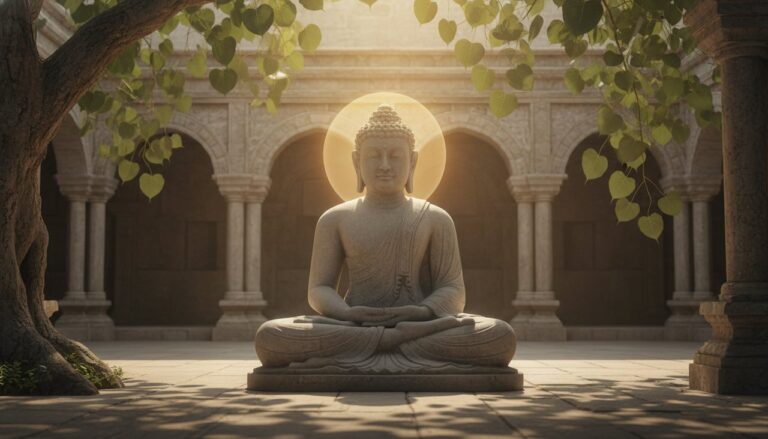

Why the Lotus Stays Clean in Muddy Water
Superhydrophobicity in lotus leaves reveals a biological blueprint for resilience: navigating modern complexity by mastering the art of detachment.
A water droplet lands on a lotus leaf and beads up like liquid mercury. When the breeze tilts the leaf, the droplet rolls across the waxy surface, sweeps micron-scale dust off its path, and leaves the green tissue dry.
That image carries two stories at once. One belongs to materials science. The other belongs to a 2,500-year-old conversation about how a mind survives contact with chaos. The interesting work happens where they meet.
How the Leaf Repels Water
Botanists call this phenomenon superhydrophobicity. It was first formally described by Wilhelm Barthlott and Christoph Neinhuis in their 1997 paper in Planta, where they coined the term “Lotus Effect” to describe the self-cleaning surface of Nelumbo nucifera.
The mechanism depends on two specific measurements. The water contact angle on a lotus leaf exceeds 150 degrees, meaning droplets refuse to spread. The roll-off angle drops below 10 degrees, meaning even a slight tilt sends them moving.
Under an electron microscope, the surface reveals two stacked layers:
- Papillae: tiny bumps roughly 10 to 20 micrometers tall that prevent water from contacting the cell wall directly.
- Wax crystals: nanoscale hydrophobic structures coating each papilla, adding a second tier of repulsion.

This dual structure traps a thin cushion of air beneath each droplet. Gravity then turns each bead into a tiny biological broom that lifts particles as it rolls.
The takeaway is structural rather than poetic: purity, in this organism, is an active mechanism. The leaf is not isolated from dirt. It is engineered to dispose of dirt continuously.
What the Sutras Actually Say
The Buddhist canon does not romanticize the lotus. It uses the plant as a precise simile, and the sources are surprisingly specific.
In the Aṅguttara Nikāya (AN 4.36), the Buddha tells the brahmin Doṇa that he is “like a lotus, born in water, grown in water, that rises above the water and stands unsoiled by it.” The grammar matters here. The lotus is described not as avoiding water but as growing through it.
The Saddharma Puṇḍarīka Sūtra, often called the Lotus Sutra, builds its title on the same logic. In Chapter 15, the bodhisattvas who “spring up from the earth” are described in lotus terms because they emerge from samsara without bringing its residue with them.
The mud is not the obstacle. The mud is the substrate that the root system needs.
This reading reframes the word “stain” itself. In context, stain does not mean ordinary dirt. It points to three specific mental reactions: craving, aversion, and delusion. These are what the canonical texts call the kleshas, and they are the actual targets of the lotus simile.
How the Image Becomes Iconography
Different Buddhist traditions encode the lotus differently, and the differences matter more than most popular summaries admit.
In Vajrayana iconography, color carries doctrinal weight. The Five Wisdoms map to five Buddha families, each with its own lotus color in many ritual texts:
- White lotus: associated with the Mirror-like Wisdom of the Vairocana family in many tantric commentaries, though the exact mapping varies between lineages.
- Red lotus: linked to the Wisdom of Discriminating Awareness in the Padma family of Amitābha.
- Pink lotus: in East Asian iconography, often reserved for the historical Buddha himself.

The Tibetan Menri painting tradition, founded by Menla Döndrup in the fifteenth century, formalized these conventions into measurable iconometric rules. A Buddha’s lotus throne carries multiple petal layers, while a bodhisattva’s seat uses a simpler arrangement. The visual hierarchy maps to a doctrinal hierarchy of mind.
What the artist draws is not decoration. It is a memory device for what the meditator is supposed to construct internally.
From Image to Practice
Lotus visualization is not, contrary to some popular accounts, a core practice in the Visuddhimagga. Buddhaghosa’s classical fifth-century manual lists ten kasiṇa objects for concentration training. The lotus is not among them.
Where lotus visualization does appear in a fully structured form is in the Pure Land and tantric corpus. The Amitāyurdhyāna Sūtra devotes its seventh contemplation to a lotus throne with eighty-four thousand petals, each petal carrying eighty-four thousand veins, each vein emitting eighty-four thousand rays. The numbers are deliberate. They overwhelm the discursive mind into a single visual field.
Practitioners working with this material typically anchor attention in three layers:
- The vertical stem: a posture cue, mirrored in the practitioner’s own spinal alignment.
- The water surface: the line where attention crosses from sensory input into reflective awareness.
- The petal opening: a release cue, paired with the out-breath.
The breath pairing is the operational hinge. On the in-breath, attention follows the stem upward. On the out-breath, the petals open. The visualization moves with the body rather than against it, which is what keeps the practice from collapsing into mental drawing.
The Lotus Effect in Digital Samsara
The original Sanskrit word samsara means “wandering through” or “continuous flow”. In its modern register, it maps cleanly onto the condition most knowledge workers describe: a constant stream of inputs, each demanding contact, none deserving residence.
Boundary-setting is the psychological analogue of the wax crystal layer.
This is where digital burnout enters the same conceptual frame as the kleshas. The mechanism of harm is not the volume of inputs alone. It is the residue each input leaves when it sticks longer than its useful contact window.
In subreddits like r/Buddhism and r/Meditation, this framing surfaces in practical terms. Users describe a “hydrophobic mindset” as the deliberate construction of contact-but-not-attachment with information streams.
The habits that correspond to the leaf’s mechanism are unglamorous:
- Muting non-essential notifications, which functions as the structural roughness that prevents inputs from spreading.
- Time-windowing communication, which mimics the roll-off angle that ensures regular clearance.
- Source curation, which acts as the wax layer determining which substances even get to land.
Mapping the Mechanism
The cleanest way to hold all three layers together is in a single side-by-side reading. Each row describes the same function operating in a different register.
| Layer of the Lotus | Buddhist Correlate | Modern Practice |
|---|---|---|
| Papillae (surface roughness) | Mindfulness (sati), the granular awareness of contact | Notification filtering, inbox triage |
| Wax crystal layer | Ethical precepts (sīla), pre-decided refusals | Pre-set rules: no email after 8pm, no scrolling in bed |
| Roll-off angle | Equanimity (upekkhā), letting reactions pass | Cognitive defusion, end-of-day reflection |
| Stem verticality | Right concentration (samādhi) | Posture, single-tasking blocks |
| Petal opening | Wisdom (paññā), clear seeing | Reflective writing, structured debriefs |
Reading the table top to bottom gives the order of training. Reading it column to column shows the same mechanism in three vocabularies.
The Practical Anchor
The biology proves a small but stubborn point. A surface can sit inside a high-contact environment and still discharge what touches it, provided it has the right structure. The structure is not heroic. It is geometric.
For a daily anchor, three concrete cues turn the metaphor operational:
- Visual cue: place a lotus image where the eye lands first in the morning, before any screen. The image is a contact-decision, not decoration.
- Sensory cue: pair the first deep out-breath of the day with the mental phrase “let it roll off”. Repeat it once at any moment of friction.
- Behavioral cue: at the end of the day, name one thing that landed but did not need to stay. The act of naming is the roll-off angle.
None of this requires belief in any particular tradition. It requires only the recognition that contact and residue are two separable phenomena, and that the separation can be designed.
Frequently Asked Questions
Why does the lotus leaf repel water?+
The leaf's surface has microscopic bumps and wax crystals. These trap air, preventing water from direct contact. Droplets then roll off, carrying impurities away.
What does "staying clean in the mud" mean?+
This Buddhist concept, "chu ran bu ran," means purity isn't escaping worldly troubles. Instead, the 'mud' of life provides essential nutrients. It fuels upward growth, mirroring the lotus's journey.
How is the lotus used in meditation?+
In Lotus Visualization, practitioners mentally follow the plant's growth from seed in mud to blooming flower. This exercise symbolizes the mind's journey from confusion to clarity. It trains attention and helps repel negative thoughts.
How can the lotus effect help digital life?+
The lotus offers a framework for existing in digital environments without absorbing negativity. Setting boundaries, like muting notifications or selecting quality information, builds a 'hydrophobic mindset.' This helps manage digital burnout.
What does the lotus symbolize generally?+
The lotus commonly symbolizes purity, enlightenment, and rebirth. Its journey from murky waters to a beautiful, unstained bloom resonates across many cultures. It often represents spiritual awakening and inner peace.
Is a lotus different from a water lily?+
Yes, they are distinct plants. Lotus flowers rise significantly above the water on thick stems, while water lily pads and blooms float directly on the surface. Lotuses also have unique seed pods.
Is the lotus important in other cultures?+
Yes, the lotus holds deep cultural and spiritual meaning beyond Buddhism. In ancient Egypt, it symbolized creation and rebirth. In Hinduism, it is associated with divine beauty and purity.
Can you grow a lotus flower at home?+
Yes, lotuses can be grown in containers with ample sunlight and standing water. They require specific care, including proper dormancy and nutrient-rich soil. They are generally hardy plants.