

Your Nervous System Knows You’re Faking It
From corporate icons to clinical lighting, we examine the toll of forced optimism and why reclaiming our shadows is essential for human dignity.
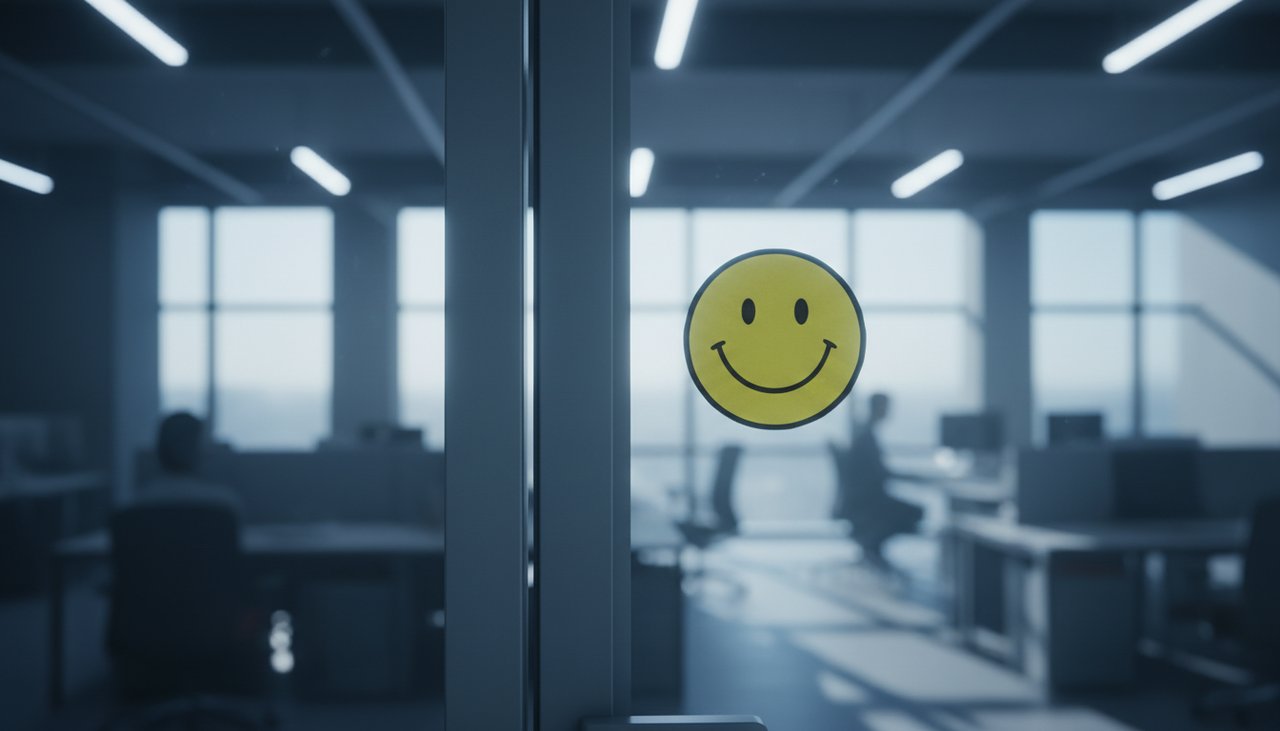
In 1963, graphic designer Harvey Ball sketched a yellow circle with two dots and a simple curve. An insurance company commissioned the image to boost employee morale after a difficult corporate merger. That yellow circle now stares out from office walls, chat applications, and wellness branding across the world — not as warmth, but as a permanent instruction: perform contentment, regardless of what is actually happening inside you. This global symbol of joy did not start as a spontaneous expression of human connection. It was a management tool designed to mask the friction of alienated labor.
Anatomy of a Forced Smile
We often treat the human face as a professional asset. When our expressions are sold as part of a service, the body carries the weight of uncompensated emotional labor. Psychologist Naoto Nambu identified this phenomenon as Smile Mask Syndrome.
He studied workers who felt unable to drop their cheerful expressions, even while experiencing deep internal distress. In these cases, the physical act of smiling becomes disconnected from the person’s actual feelings. This creates a psychological gap that widens quietly over time.
While this draws from the Japanese concepts of Tatemae, the public face, and Honne, one’s true feelings, it has become a global standard in commerce. These two forces — the performed self and the actual self — are supposed to coexist. The longer the distance between them, the more energy the body spends maintaining the gap.
Some corporations now use software to score a worker’s lip curvature on a scale from zero to one hundred. Human emotion is no longer a feeling. It is a cold metric for performance, audited in real time by an algorithm that cannot register what it costs.
Toxic Positivity
The requirement to appear optimistic has a specific, aggressive look. It relies on visual environments engineered to remove all shadows and nuance from our surroundings — what designers and marketers now call wellness architecture or the Instagram aesthetic. This visual language demands constant engagement but offers no place for the mind to rest.
In the digital world, this manifests through high-key lighting and over-exposure. Social media feeds are saturated with pinks and yellows. These visuals keep the viewer in a state of high arousal, making it structurally difficult to disconnect.

This design philosophy extends to physical spaces built specifically for wellness. Clinical minimalism strips out the textures that make us feel safe or signal that rest is permitted. These environments feel clean, but they offer little shelter to a tired mind.
Bright, cold lighting in these spaces is often calibrated to suppress melatonin production. This keeps the nervous system in an artificial state of alertness. It becomes nearly impossible to acknowledge exhaustion when the environment is engineered to prevent the lights from dimming.
Sensory Profile of Exhaustion
This psychological alienation does not stay abstract. It converts into a physical collapse of the senses — the body making legible what the mind has been forced to ignore.
When the nervous system is forced to perform emotionally for too long, it changes how we perceive the world. Fatigue is more than being tired; it is a shift in physical reality. This collapse usually appears in three distinct ways:
- High-saturation colors begin to feel like aggressive visual noise.
- The brain loses its ability to filter background sounds, making the hum of a room feel like metal friction.
- A person feels a physical disconnect from their environment, as if touching the world through a thick barrier.
The body eventually goes on a physiological strike. It refuses to process more information or project more energy outward. This is not weakness. It is a natural defense against an environment that demands constant outward radiation.
Melancholy
This sense of suffocation is not a new invention. In the nineteenth century, writers had a specific vocabulary for this hollow existence that modern productivity culture works hard to suppress. Charles Baudelaire documented this mental landscape with clinical precision.
He did not treat gloom as a disease, but as a rational response to an alienating world. He saw the sky as a heavy cover pressing down on the soul — a image that maps exactly onto what workers experience when the gap between Tatemae and Honne becomes unmanageable.
When the low and heavy sky weighs like a lid, upon the spirit groaning in tedious prey.
Baudelaire articulated the quiet fury that arises when a person is trapped inside a system they cannot name and cannot exit. Today, that same anger stays hidden behind a forced smile — contained by a culture that refuses to acknowledge the validity of its own shadows.
Dignity of Shadows
Ending this cycle of fatigue requires stopping the performance of joy on command. That means reclaiming the value of darker moods and refusing to counterfeit a happiness we do not feel. Authentic presence is only possible when we allow ourselves the full range.

In art, a flat, bright image carries no narrative weight. Meaning comes from chiaroscuro — the deliberate contrast between light and dark. A human psyche without shadows is equally flat. It lacks the friction needed to generate anything real.
Viktor Frankl argued that meaning is found by integrating our pain, not by concealing it behind a yellow icon. True resilience is not the absence of suffering. It is the ability to hold suffering without being destroyed by it.
One concrete way to begin is this: each evening, allow yourself ten minutes of non-performative solitude. No productivity, no social presence, no curated mood. This is not meditation in any formal sense. It is simply the act of letting the nervous system register its actual state — a practice some call shadow work, and what Frankl might have called the quiet precondition for any honest meaning-making.
Historically, cultures built formal structures for exactly this kind of processing. Victorian mourning jewelry gave people a dignified, socially sanctioned space for difficult feelings. Grief was not a system failure. It was evidence of deep human attachment — something worth marking, not hiding.
The yellow smiley face began as a tool to smooth over corporate tension. But a face without contours is just a mask. Our chronic fatigue is a healthy rebellion against the demand for constant light. We find our dignity not by eliminating the darkness, but by accepting our full emotional reality — shadows included.

Frequently Asked Questions
What is 'Smile Mask Syndrome' and how does it contribute to mental fatigue?+
Smile Mask Syndrome, a concept identified by psychologist Naoto Nambu, describes the phenomenon where individuals feel compelled to maintain a cheerful expression despite experiencing internal distress. This creates a significant psychological gap between outward appearance and true feelings, leading to uncompensated emotional labor and profound mental exhaustion, particularly prevalent in service-oriented roles within commerce.
How does toxic positivity in our environments affect our mental well-being?+
Toxic positivity manifests through aggressive visual and social cues that demand constant optimism, often through high-key lighting, saturated colors, and minimalist designs in both digital and physical spaces. This relentless demand for cheerfulness suppresses the natural inclination to rest or acknowledge discomfort, keeping the nervous system in an artificially alert state and preventing genuine emotional processing, ultimately exacerbating mental fatigue.
What are the physical signs that your nervous system is overwhelmed by emotional suppression?+
When the nervous system is forced into prolonged emotional performance, it signals exhaustion through distinct sensory shifts. High-saturation colors may begin to feel like aggressive visual noise, background sounds can transform into grating friction, and one might experience a physical disconnect from their surroundings, as if perceiving the world through a thick barrier. These are the body's natural defense mechanisms, initiating a physiological strike against constant outward radiation.
How can embracing 'shadows' or negative emotions lead to greater mental resilience?+
True mental resilience emerges not from suppressing difficult emotions, but from integrating them into our full emotional reality. Just as chiaroscuro gives depth to art, acknowledging our 'shadows' provides the necessary friction for authentic meaning and self-understanding. Viktor Frankl suggested that purpose is found within suffering, and reclaiming the dignity of darker moods allows for genuine presence and a more robust emotional landscape, rather than a flat, performative happiness.
What is the core 'Happiness Paradox' the article describes?+
The 'Happiness Paradox' highlights how the societal and corporate demand for constant, performative joy can paradoxically lead to profound mental fatigue and emotional alienation. What began as a tool for morale, like the iconic smiley face, has evolved into a cultural mandate that suppresses authentic human experience, creating a disconnect where the relentless pursuit of happiness ultimately diminishes genuine well-being and prevents us from acknowledging our true emotional states.