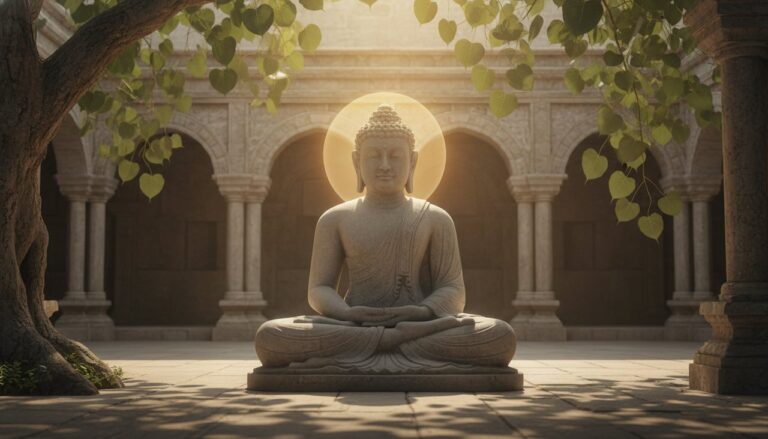

Why Was the Buddha Once a Tree?
The Bodhi tree was no mere symbol, but a biological tool—a logistical anchor that provided the physiological stability required for Siddhartha’s clarity.
The Bodhi tree wasn’t a backdrop. It was a piece of equipment—a biological system that provided the specific physiological conditions Siddhartha needed to complete what he was attempting. Understanding that changes how you read the entire tradition.
Once you stop treating the forest as a stage set, Ahimsa starts to make more practical sense. Protecting the ecosystem isn’t just an ethical position; it’s a way of preserving the external infrastructure that makes internal clarity physically possible.
The Practitioner and the Land
It’s a mistake to look at Siddhartha Gautama’s connection to the forest as purely symbolic. He didn’t undergo some mystical botanical transformation; he simply reached a point where the distinction between his body and the landscape stopped being relevant. This is Pratītyasamutpāda, or dependent origination, stripped of the abstract jargon. It’s the basic realization that the person sitting is defined by the ground beneath them.
The historical record reflects this throughout his life, from the Sal grove at his birth to the twin trees where he died. These locations weren’t chosen for the “aesthetic.” They provided the physical baseline—the regulated air, the shade, and the deep stillness—that made his meditation possible. The forest was an active partner in his realization because it stabilized the specific conditions his body and mind needed to settle.
When you treat the Bodhi tree as a functional requirement for awakening rather than a metaphor, the idea of interconnectedness becomes a matter of biology. Mental clarity is tied to the state of your surroundings. If the environment is degraded, the practice suffers. Taking care of the space around you is just a practical step in maintaining the mind itself.
The Logic of the Bodhi Tree
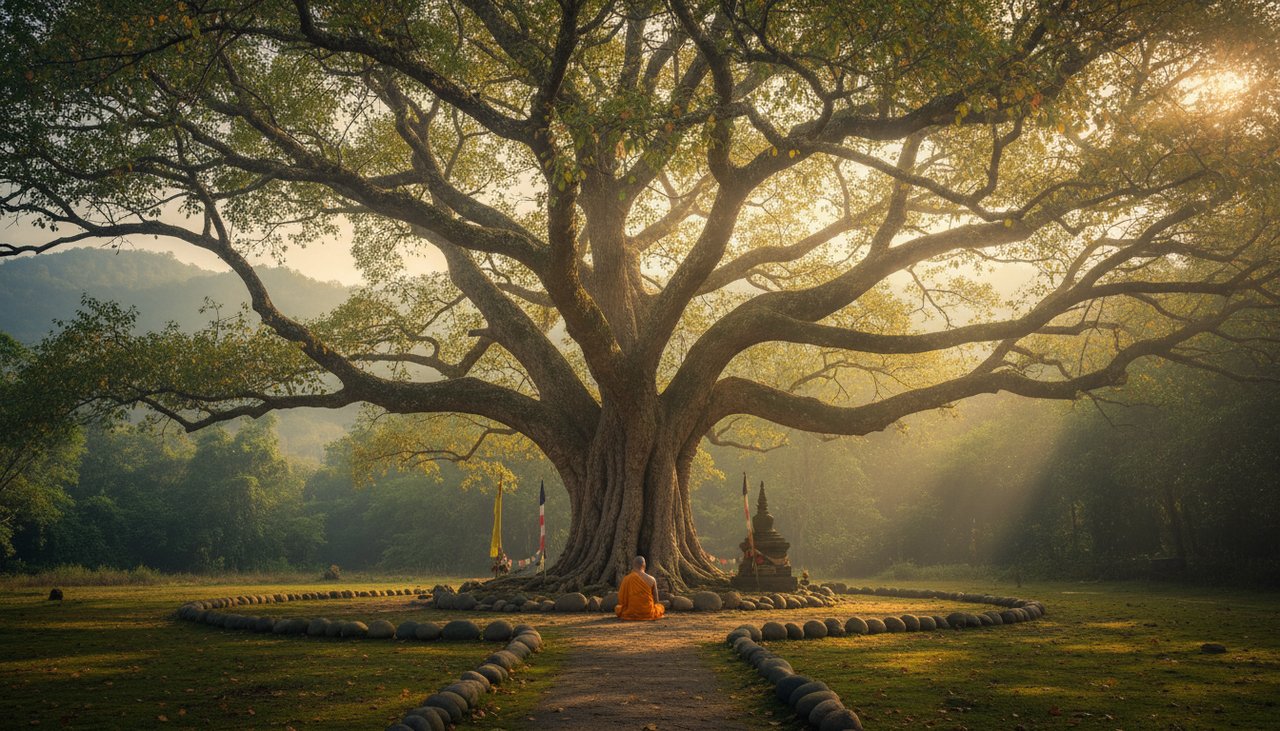
Siddhartha’s choice to sit under that tree at Bodh Gaya was a practical response to his own physical limits. After years of extreme asceticism had left him exhausted and weak, he realized that a broken body couldn’t support a clear mind. He needed a place where the physical conditions wouldn’t fluctuate while he made a final effort. The tree wasn’t a decoration; it was a logistical necessity. It offered the shade and the stillness required for him to stay in one spot without the environment becoming another distraction to manage.
The “armies of Mara” described in the texts represent the mental friction that any practitioner eventually hits: the restlessness, the physical discomfort, and the sudden, intense urge to just get up and do something else. While his mind was moving through these cycles of doubt and craving, the tree remained completely fixed. It served as a literal sensory anchor. Having that unmoving trunk at his back gave him a physical baseline to return to whenever his internal state started to spin.
The clarity he reached by dawn—the understanding of how suffering is built and how it can be stopped—happened because his mind was finally allowed to stabilize. The tree provided the necessary ecological support for that shift. It’s a reminder that mental clarity doesn’t happen in a vacuum; it requires an environment that allows the body to settle so the mind can follow. Who Was the Buddha?
The Forest as a Framework
The Sal tree (Shorea robusta) marks both the beginning and the end of the Buddha’s life. This isn’t just a convenient framing device for a story; it highlights a life lived entirely within the physical logic of the forest. Even the accounts of trees blooming out of season at his passing point to a simple reality: the practitioner and the land are synced. When the internal state reaches a certain point, the environment reflects it.
This is where Ahimsa, or non-violence, becomes more than just an ethical rule. In a forest practice, it’s a functional necessity. You protect the grove because the grove is what provides the stability for your focus. It’s likely why the tradition assigns a specific tree species to every Buddha across different eras—the Pippala for Siddhartha, others for his predecessors. It treats awakening as a collaborative effort. You don’t reach that level of clarity alone; you do it by working in tandem with the specific ecology around you.
Biological Interdependence
This is why sitting under a tree doesn’t automatically lead to clarity. A common mistake is treating the forest as a commodity—a “quiet space” to be consumed. If you go into the grove with a restless, demanding ego, trying to extract peace from the landscape, you’re still carrying the friction of the city with you. The environment won’t settle a mind that is actively fighting its surroundings.
The biological case for forest practice is more specific than “nature is calming.” Trees release phytoncides—airborne chemical compounds that measurably lower cortisol levels and reduce the inflammatory markers associated with sustained mental stress. The stillness of a grove isn’t just acoustic; it’s biochemical. True grounding happens when you stop treating the tree as an object and start treating it as the literal floor of your nervous system. If the land is degraded, the practitioner loses that baseline. You can’t find internal stability if the ground you’re sitting on is being stripped away.
Practical Grounding
You don’t need to visit a specific pilgrimage site to find this kind of stability; any local tree works as a functional anchor. The goal isn’t to hunt for a mystical state, but to use the tree’s physical presence to steady your attention. Next time you’re outside, try this sequence:
- Place one hand flat against the bark and hold it there until you can feel the temperature of the wood registering in your palm.
- Notice the immediate drop in temperature in the shade versus direct sun—let that contrast become your first point of focus.
- Track the wind moving through the canopy. Follow a single branch, not the whole tree.
- If you’re sitting, feel the physical pressure of your back against the trunk or the soles of your feet on the roots.
This level of engagement slows the mind without forcing it. Instead of analyzing the tree from a distance, you’re occupying the same space. How to Practice Deep Relaxation? If you find yourself overcomplicating it or “trying” too hard, return to the bark temperature. That single sensation is enough to pull attention back out of abstraction and into the actual environment you’re sitting in.
Frequently Asked Questions
Was the Buddha literally a tree before he was human?+
No, the Buddha, Siddhartha Gautama, was a human being, a prince who sought liberation. The idea of the Buddha being a tree is not a literal transformation but a deep symbolic relationship, particularly with the Bodhi Tree under which he attained enlightenment.
What does the Bodhi Tree symbolize in Buddhism?+
The Bodhi Tree symbolizes wisdom and the enduring nature of the Buddha's teachings. It served as a potent emblem and a silent witness to Siddhartha Gautama's pivotal spiritual journey and his attainment of supreme enlightenment.
How is the concept of interconnectedness represented by the Buddha's connection to trees?+
The Buddha's life events, from birth under a Sal tree to enlightenment under the Bodhi Tree and passing between two Sal trees, highlight his deep connection with nature. This illustrates the Buddhist teaching of Dependent Origination, which states that all phenomena are interconnected and nothing exists in isolation, just as a tree is sustained by its environment.
Are there other trees significant in the Buddha's life besides the Bodhi Tree?+
Yes, the Buddha's birth occurred under a Sal tree in Lumbini, and he passed into Mahaparinirvana between two Sal trees in Kushinagar. These trees frame his entire human existence, underscoring nature's role.